Space has a way of capturing attention the moment it enters the room. With a few simple materials and a little imagination, the solar system becomes something kids can touch, build, and truly understand.
These hands-on projects turn abstract planets into colorful, memorable experiences that spark curiosity naturally.
I’ve gathered ideas that work for classrooms, home learning, and weekend creativity, all designed to make space science feel exciting rather than overwhelming.
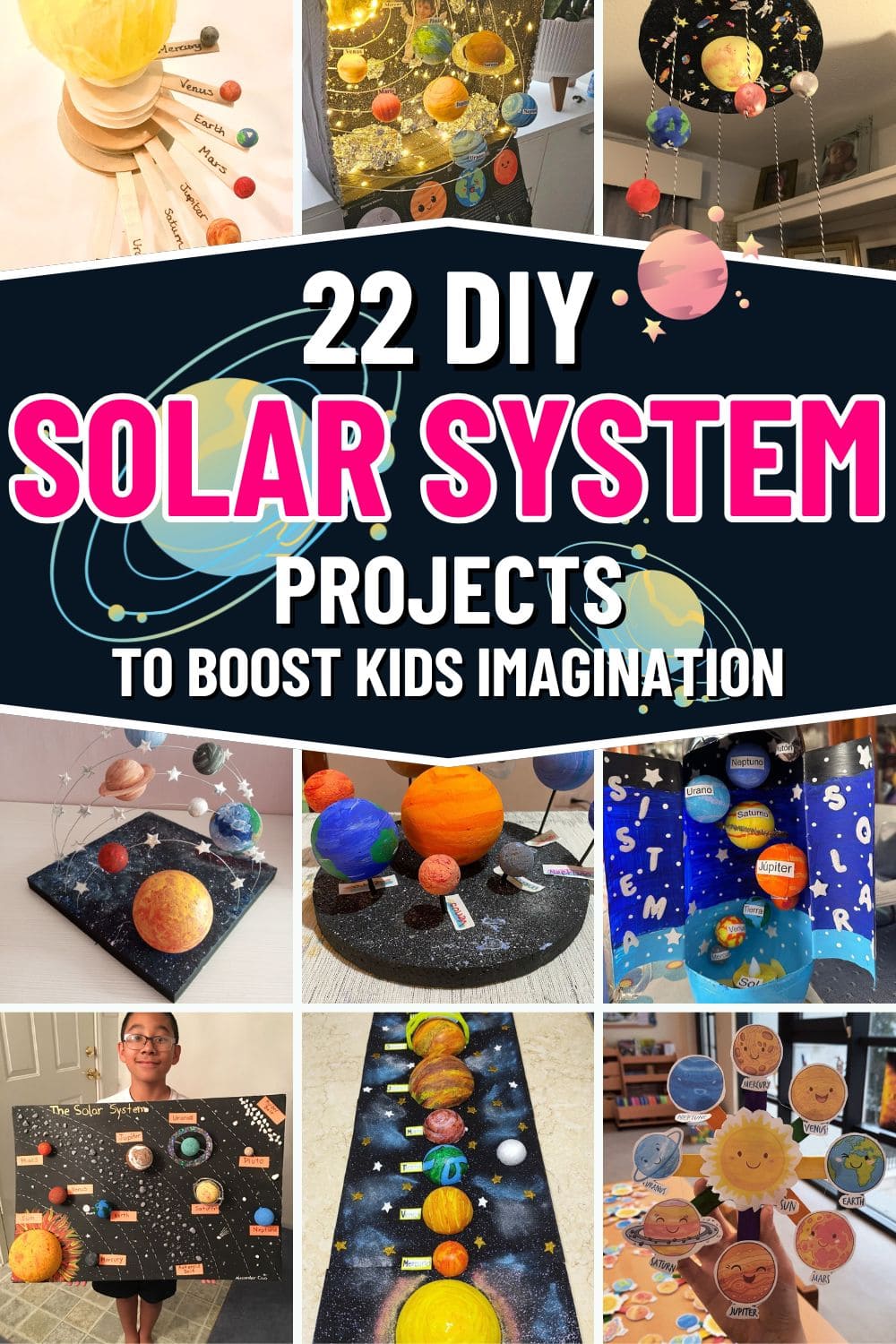
#1. Solar System Stick Spinner

I believe hands-on movement helps children remember ideas longer, and this cheerful stick spinner proves it.
The planets radiate from the Sun in a clear, playful layout that invites turning, pointing, and naming.
Each face adds warmth, turning a science concept into something friendly rather than abstract. It fits perfectly into classroom centers, small group lessons, or take-home activities.
- Printed planet cutouts, 8–10 pieces, about 5–6 cm each
- Thick craft sticks or wooden spatulas, 4–5 pieces, 15–18 cm long
- Cardstock or thin cardboard backing, 1 sheet
- Black marker for labels
- Hole punch or push pin (for center joint)
- Paper fastener (brad), 1 piece
- Glue stick or white school glue
- Child-safe scissors
- Thick craft sticks or wooden spatulas, 4–5 pieces, 15–18 cm long
-
Cut out each planet and label them clearly with names underneath.
-
Glue one planet to the end of each craft stick, pressing firmly and letting them dry.
-
Stack the sticks in a star shape with the Sun piece placed at the center.
-
Punch a small hole through all layers in the middle and secure with a paper fastener.
-
Gently spread the sticks so planets are visible and can rotate smoothly.
-
Use the spinner to quiz planet names, order from the Sun, or simple space facts during lessons.
#2. Astronaut Planet Balloon Canvas Art
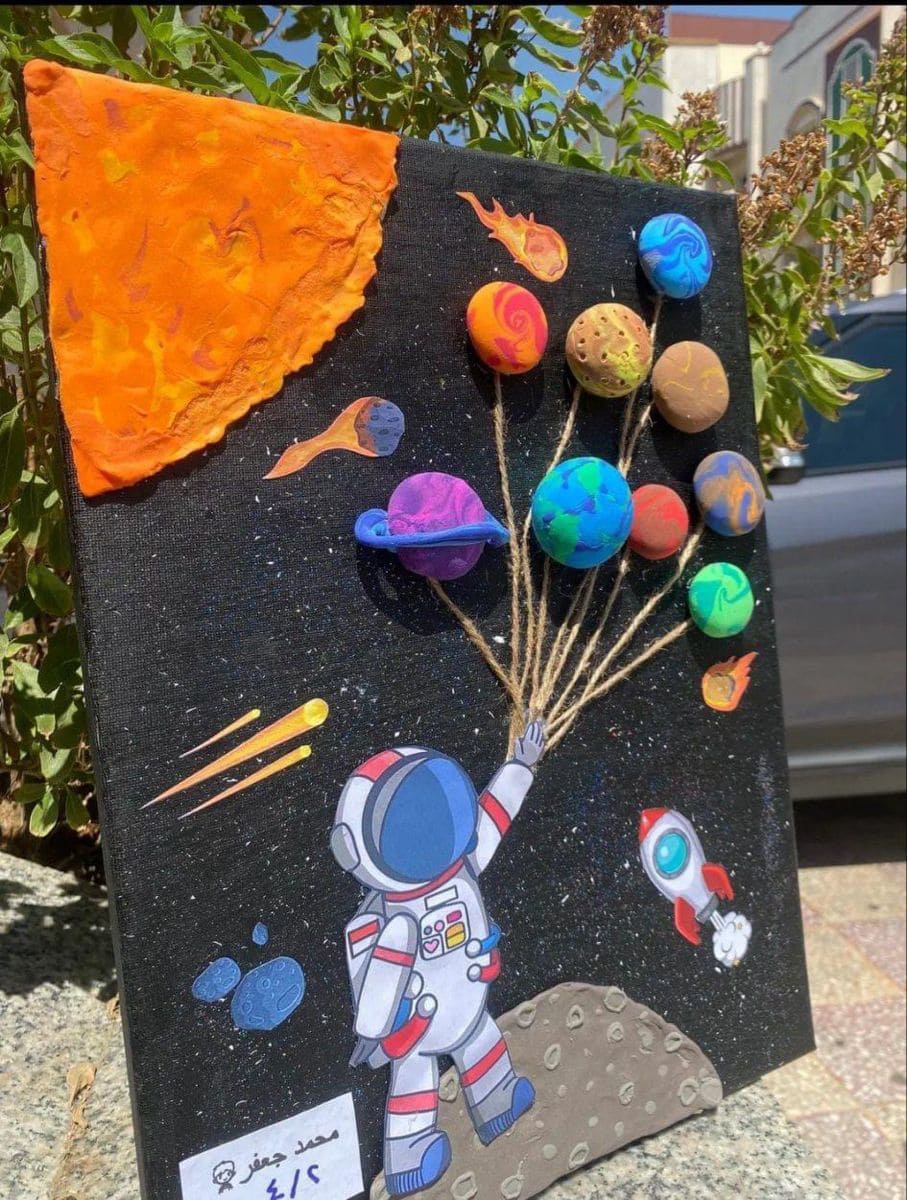
Wow, this project instantly feels like imagination breaking free from gravity. Clay planets float upward like balloons, turning the solar system into a playful, story-driven scene.
Textured paint and twine add depth, making the planets stand out from the dark, starry background.
The astronaut illustration anchors the composition and gives the whole piece a sense of motion.
- 1 canvas board, approx. 30 × 40 cm
- Air-dry clay, about 300–400 g total (planets and Sun)
- Acrylic paints (black, orange, blue, green, purple, yellow, white)
- Jute twine or string, 6–8 pieces, each 12–18 cm long
- Printed astronaut and space-themed cutouts (or hand-drawn alternatives)
- Craft glue or hot glue gun with 3–4 glue sticks
- Small paintbrush set
- Toothpick or sculpting tool (for clay texture)
-
Paint the canvas black and splatter white paint to create a starry space background.
-
Shape clay into planet sizes, add surface texture, and let them dry completely.
-
Paint each clay planet and allow the colors to set before attaching.
-
Glue twine to the back of each planet, then secure the strings to the astronaut’s raised hand.
-
Attach planets, sun, and decorative elements to the canvas, adjusting spacing for a floating effect.
#3. Hanging Solar System Ceiling Mobile

You create a sense of motion the moment these planets start gently swaying overhead. Suspended at different lengths, each sphere feels like it’s drifting through its own orbit.
The painted ceiling base anchors the scene, while small space-themed stickers add playful detail without clutter.
Plus, scale stays simple but effective, helping viewers recognize each planet instantly.
- 1 round foam or cardboard base, 35–40 cm diameter
- 9 foam balls for planets (Sun 8–10 cm, planets 3–6 cm diameter)
- Black acrylic paint, about 50 ml (base background)
- Acrylic paints in assorted colors (yellow, blue, green, red, brown, white)
- Twine or baker’s string, 6–8 pieces, each 40–70 cm long
- Space-themed stickers or paper cutouts, 15–25 pieces
- 1 screw hook or ceiling hook (adult installation)
- 1 hot glue gun with 3–4 glue sticks
-
Paint the round base black and let it dry, then add stars or stickers for decoration.
-
Paint each foam ball as a planet, adding light texture or color blending for detail.
-
Cut strings to different lengths and glue one planet to the end of each string.
-
Attach the strings evenly around the base, spacing planets so they don’t overlap.
-
Secure a hook at the top of the base and hang the mobile from the ceiling, adjusting lengths as needed.
#4. Illuminated Solar System Display Box
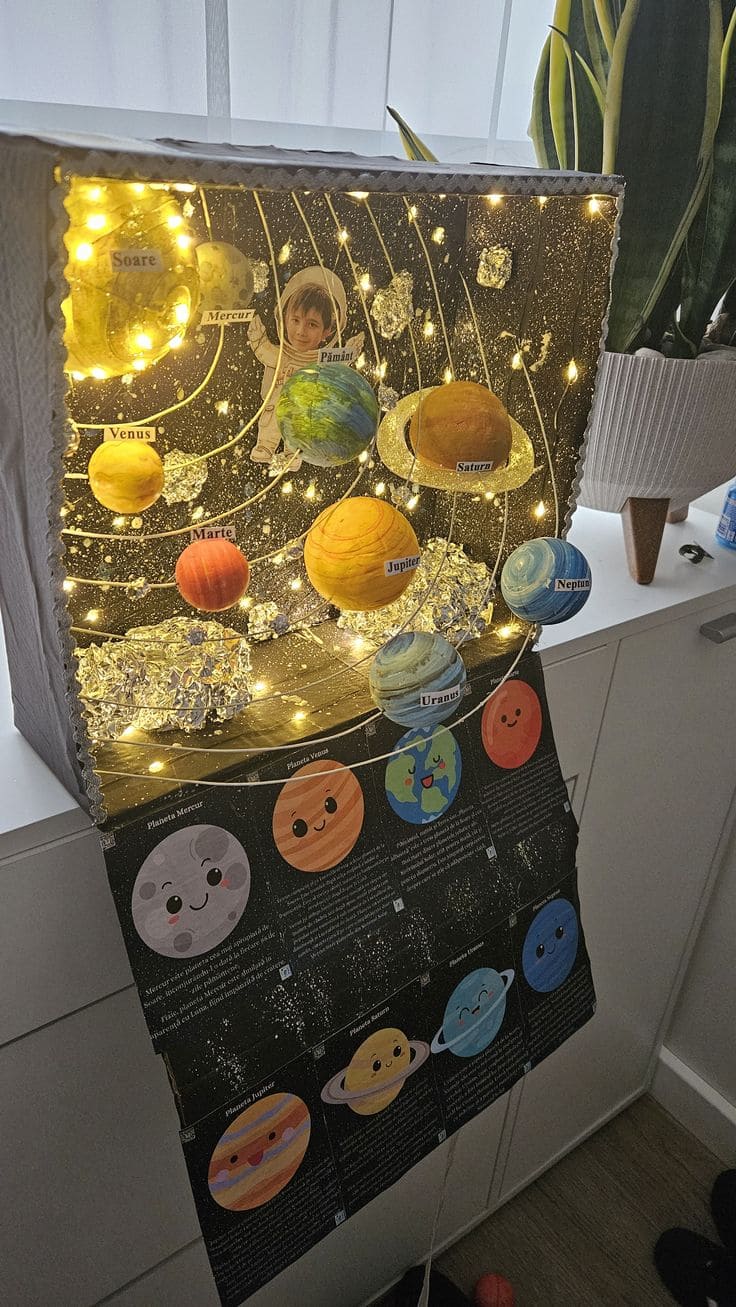
What if the solar system could glow softly while teaching planetary order at the same time?
This project combines light, texture, and depth to create a scene that feels alive even when standing still.
String lights highlight each orbit, helping planets stand out against the dark, star-speckled background.
Moreover, the layered design makes room for creativity, from foil asteroids to personal touches like a small astronaut figure.
- 1 large cardboard box, approx. 45 × 30 × 25 cm
- 9 foam balls for planets (Sun 7–8 cm, planets 2.5–5 cm diameter)
- Warm white LED string lights, 2–3 m length (battery operated)
- Black cardstock or black paint for interior (2–3 A4 sheets or equivalent paint)
- Acrylic paints (yellow, orange, red, blue, green, white, brown)
- Aluminum foil, about 1–2 sheets (asteroids and texture)
- Thin craft wire or string, about 2 m (planet orbits)
- Printed or handwritten planet labels, 2 × 4 cm each
- Hot glue gun with 4–5 glue sticks
- Small paintbrush set
-
Paint the inside of the box black and add white splatter or dots to create a starry background.
-
Paint the foam balls as the Sun and planets, letting each layer dry fully before handling.
-
Attach string lights around the interior edges and secure them with glue.
-
Shape aluminum foil into small clusters and glue them in place to form asteroid areas.
-
Hang or glue the planets along curved wire or string paths, then add labels near each one to complete the display.
#5. Textured Foam Solar System Board
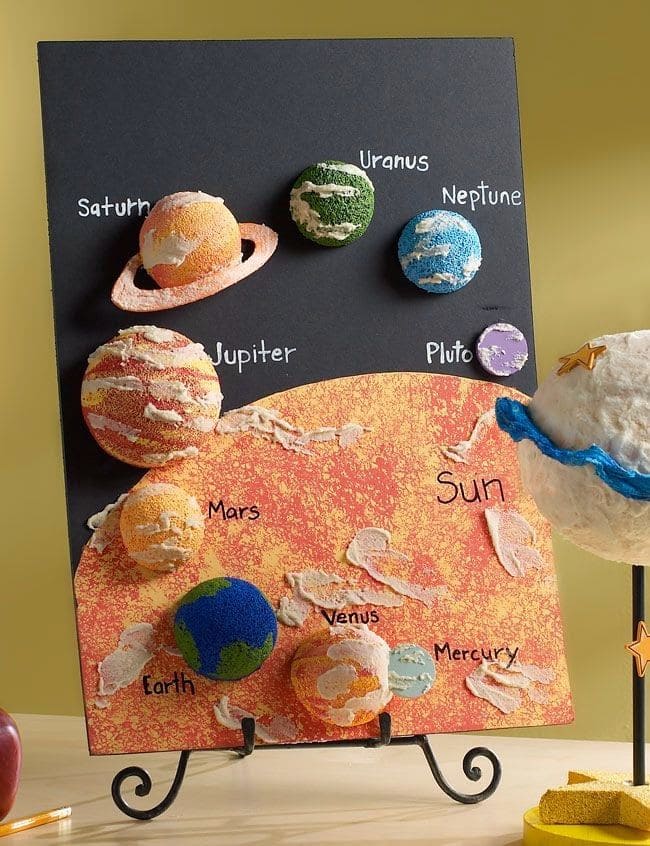
What about turning planets into something you can actually feel as well as see? This project uses thick texture and raised shapes to make each planet stand out clearly from the background.
The layered Sun acts as a visual anchor, while the smaller planets float above it in a clean, easy-to-follow layout.
Painted details and soft relief textures add depth without overcomplicating the design.
- 1 sturdy foam board or thick cardboard, approx. 30 × 40 cm
- 9 foam balls in assorted sizes (Sun 9–10 cm, planets 2.5–5 cm diameter)
- Acrylic paints (yellow, orange, red, blue, green, brown, white)
- Lightweight spackling paste or modeling paste, about 150 g
- Craft sponge or palette knife (for texture application)
- Black cardstock or black paint for background
- Fine-tip black marker or paint pen
- Craft glue or hot glue gun with 3–4 glue sticks
- Small paintbrush set
-
Paint the foam board background black and let it dry fully before adding any elements.
-
Paint the foam balls as planets, using layered colors to create surface variation, then set aside to dry.
-
Shape the Sun directly onto the board using spackling paste, spreading it into a semicircle and adding raised texture.
-
Lightly press and smooth additional paste onto the planets to create cloud bands and surface ridges, allowing partial drying for dimension.
-
Glue the planets in place above the Sun, spacing them evenly so labels remain readable.
-
Add handwritten planet names with a paint pen, then touch up colors and textures once everything is fully set.
#6. Plastic Bottle Solar System Diorama
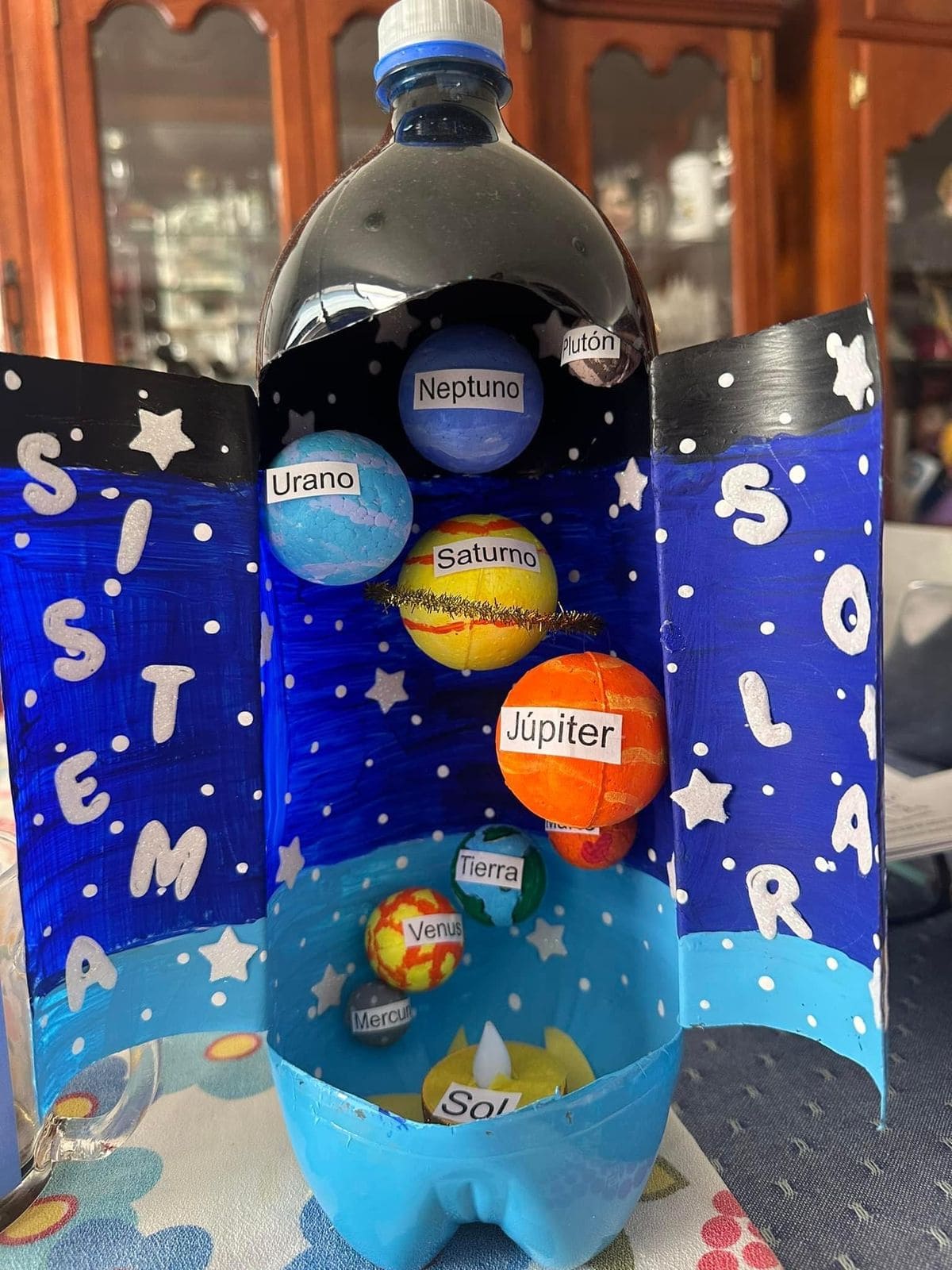
If space concepts feel abstract on paper, this project turns them into something concrete and playful.
Also, a clear bottle becomes a vertical universe where planets stack naturally from the Sun upward.
Cut-out side panels open the scene, making every planet visible at once without crowding. Painted stars and labels add clarity while keeping the build approachable.
- 1 large plastic bottle, 1.5–2 liters, cleaned and dried
- 9 small foam balls (planets 2–4 cm diameter, Sun 5–6 cm diameter)
- Acrylic paints (blue, black, yellow, orange, green, white, brown)
- 1 pipe cleaner or thin craft wire, about 15 cm (Saturn’s ring)
- White paper labels, cut into 2 × 4 cm strips
- 1 hot glue gun with 3–4 glue sticks
- Paintbrush set (small and medium)
- Craft knife or scissors (adult use recommended)
-
Cut a large vertical opening on the front of the bottle and two side flaps to create a display window.
-
Paint the inside of the bottle in dark blues and black, adding white dots for stars once dry.
-
Paint the foam balls as planets, shaping Saturn’s ring with a pipe cleaner glued around the ball.
-
Glue the Sun at the bottom, then attach planets upward inside the bottle in correct order.
-
Add labels to each planet and paint decorative details on the side flaps to finish the diorama.
#7. Solar System Popsicle Stick Spinner
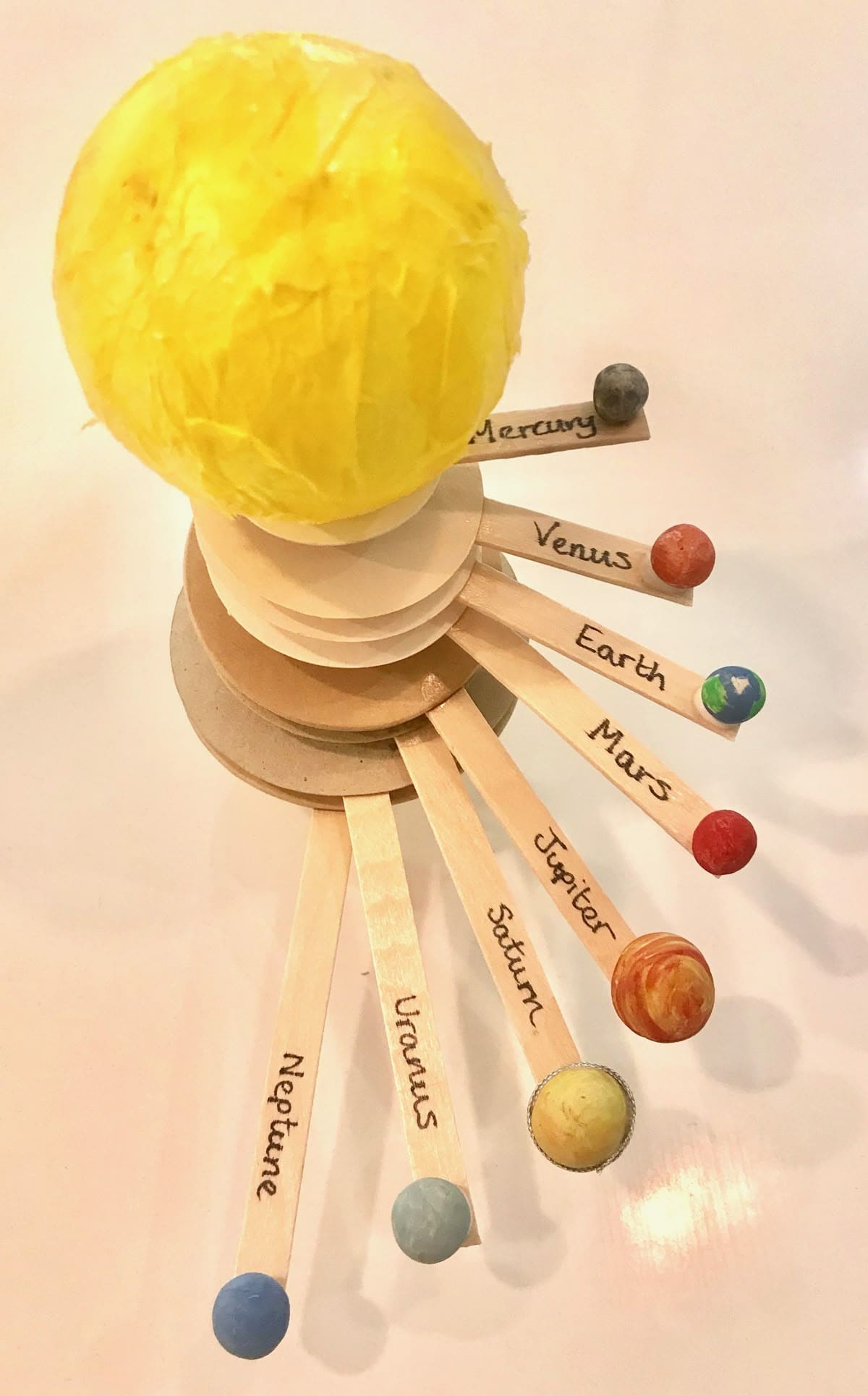
This project turns planetary order into something visual and easy to remember.
The fanned-out sticks naturally guide the eye from Mercury to Neptune, making scale and sequence clearer at a glance.
Movement adds another layer of engagement, especially for kids who learn better through interaction. The layered base keeps the structure stable without distracting from the planets.
- 9 wooden popsicle sticks, standard size (11–12 cm long)
- 9 foam balls (Sun ~8–9 cm diameter, planets 1.5–3 cm diameter)
- 1 cardboard tube or stacked cardboard circles, total height 8–10 cm
- Yellow tissue paper, 2 sheets (about 20 × 20 cm each)
- Acrylic paints (yellow, red, blue, green, brown, gray, white)
- 1 black fine-tip marker
- 1 hot glue gun with 2–3 glue sticks
-
Wrap the large foam ball with yellow tissue paper, layering slightly to create a sun-like texture, then glue in place.
-
Paint the smaller foam balls as planets, adding simple color patterns and letting them dry fully.
-
Glue one planet to the end of each popsicle stick and write the planet names along the sticks.
-
Build the central column by stacking cardboard pieces, then glue it securely onto the round base.
-
Attach the labeled sticks around the column, spacing them evenly and arranging them in correct planetary order.
#8. Mini Stick Solar System Model
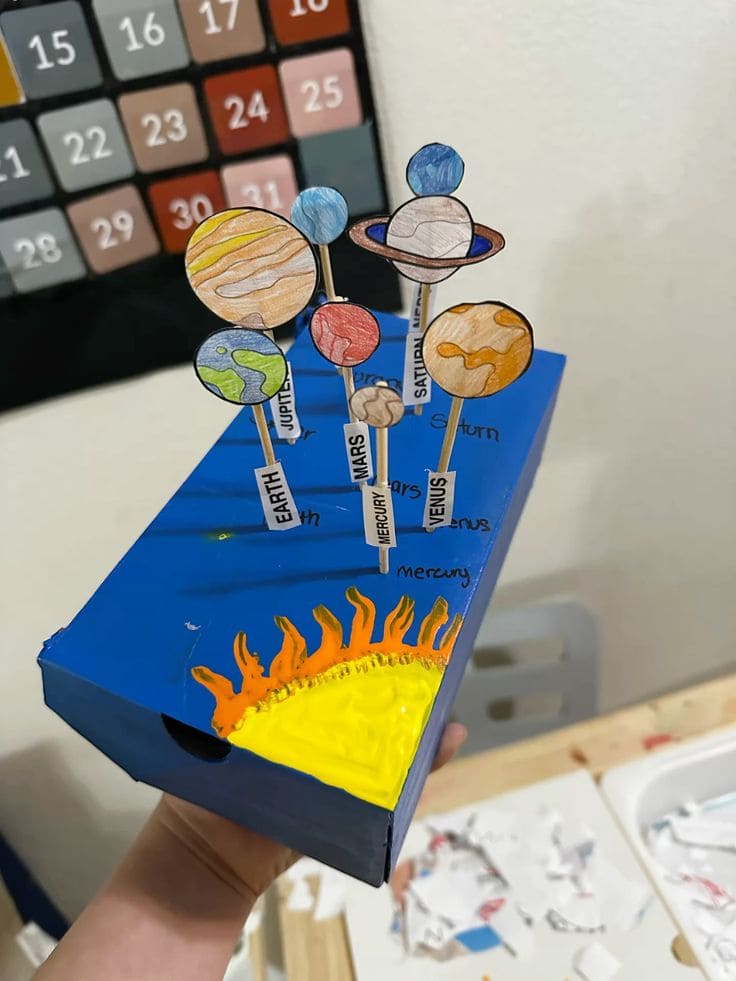
By turning simple paper cutouts into upright planets, this project makes the solar system feel playful and hands-on.
The raised design helps kids clearly see size differences and relative positions without needing a large display.
Each planet stands on its own stick, which makes labeling, rearranging, and explaining concepts much easier. The box base keeps everything compact and sturdy, perfect for desks or science fair tables.
- 1 small cardboard box, approx. 15 × 8 × 6 cm
- Thick paper or cardstock for planets, 1–2 sheets
- Wooden skewers or craft sticks, 8–9 pieces, 10–15 cm long
- Acrylic paints or colored pencils (yellow, blue, green, red, brown, beige)
- Black marker for outlines and labels
- White paper strips for planet names, 1 sheet
- Craft glue or hot glue (adult help), 1 tub
- Scissors
- Blue and yellow paint for the box base
-
Paint the cardboard box blue and add a yellow Sun design on the front; let it dry fully.
-
Draw and cut out circular planets from cardstock, keeping sizes slightly varied for realism.
-
Color each planet and outline details using a black marker then glue or tape each planet to the top of a skewer or craft stick.
-
Label sticks with planet names using small paper strips.
-
Poke holes into the box top and insert the sticks, spacing planets evenly from the Sun.
#9. Arched Orbit Solar System Sculpture
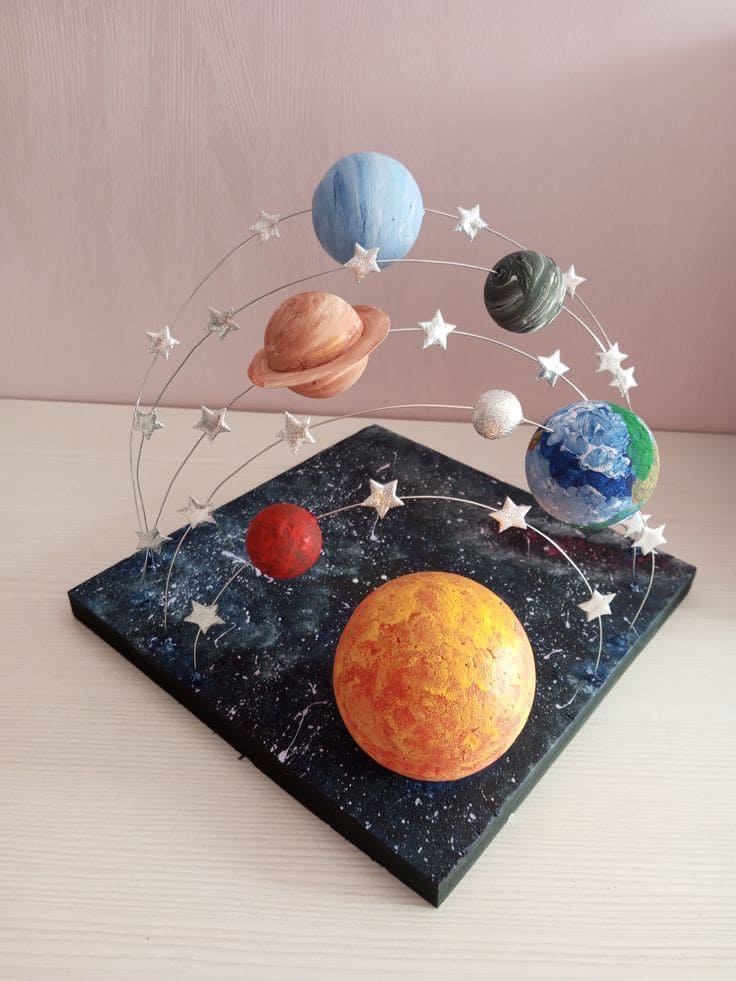
I bet this is the kind of project that makes people stop and look twice. Curved wire orbits lift the planets off the base, creating a sense of motion without needing anything to spin.
Star accents guide the eye along each path, helping the layout feel intentional instead of busy.
The raised structure keeps every planet visible from multiple angles.
- 1 square foam or wooden base, about 25 × 25 cm, 2–3 cm thick
- Aluminum craft wire, 3–4 pieces, each about 40–50 cm long
- Small star beads or foam stars, 20–30 pieces
- Acrylic paints (black, yellow, orange, red, blue, green, white, gray)
- White acrylic paint or spray for star splatter
- Hot glue gun with 4–5 glue sticks
- Small drill or awl (to make wire holes)
- Paintbrush set (small and medium)
- 9 foam balls (Sun 6–7 cm, planets 2–4 cm diameter)
-
Paint the base black and add white splatter to create a starry space background, then let it dry fully.
-
Paint all foam balls as the Sun and planets, using layered colors to add texture and depth.
-
Bend the craft wire into smooth arcs, shaping each one slightly differently to represent orbital paths.
-
Glue star beads evenly along the wire arcs, spacing them so they feel balanced rather than crowded.
-
Drill small holes into the base and secure the wire arcs upright with hot glue.
-
Attach planets to the wire or directly onto the base, adjusting heights so none overlap visually.
#10. Solar System Headband Classroom Activity
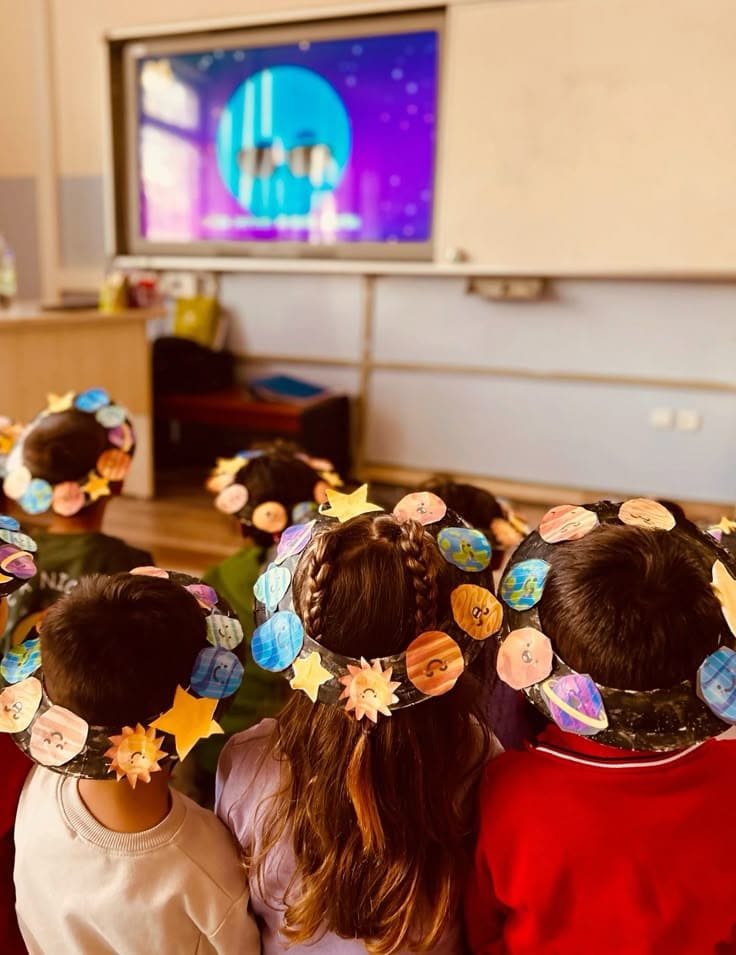
At circle time, this simple headband project turns every child into part of the solar system. Each planet becomes wearable, visible, and easy to recognize while the lesson unfolds.
The setup encourages attention without forcing stillness, since kids naturally look at one another and make connections.
It also builds quiet excitement before videos, stories, or group discussions about space.
- Black cardstock or foam sheets, one per child
- Planet cutouts printed or hand-drawn, 6–8 cm each
- Star and sun cutouts for decoration
- Child-safe scissors
- Glue sticks or double-sided tape
- Stapler or tape for sizing headbands
- Crayons or markers for coloring
-
Cut cardstock into long strips and loosely fit them around each child’s head, securing with a staple or tape.
-
Prepare planet cutouts ahead of time or let children color their own for a personal touch.
-
Glue planets evenly around each headband, mixing stars or suns between them for balance.
-
Allow everything to dry for a few minutes before wearing.
-
Use the headbands during lessons, asking children to identify planets, compare sizes, or line up in solar system order.
#11. Tabletop Solar System Model Display
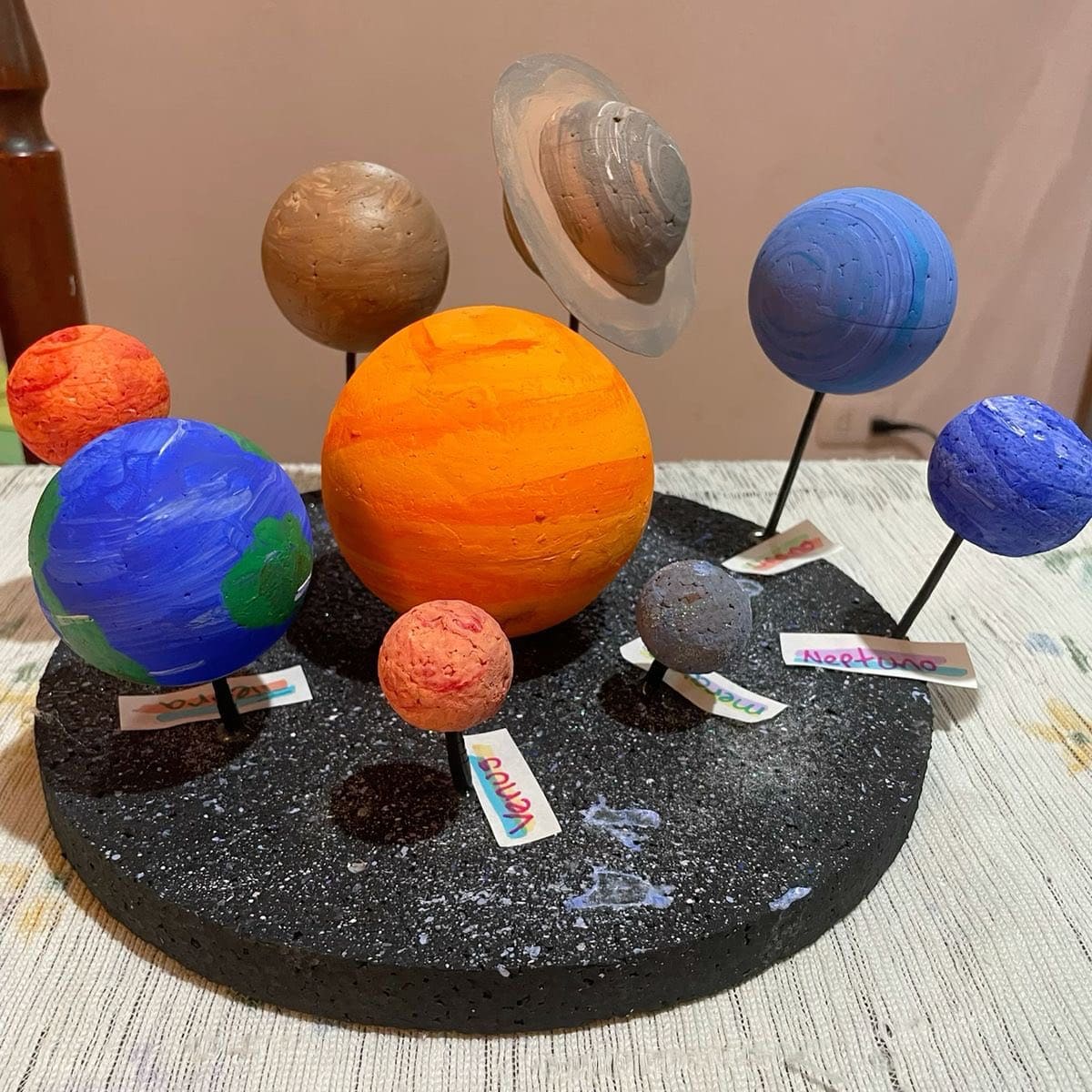
I love how this project turns a science lesson into something you can actually touch and explore. Each planet stands upright, spaced just enough to feel intentional without being overwhelming.
The painted textures give the planets personality, making them feel less like balls and more like worlds.
I find it works beautifully for school projects, learning corners, or even a child’s bedroom shelf. It quietly invites curiosity without shouting for attention.
- 1 foam board base, round, about 30–35 cm diameter, 3–4 cm thick
- 9 wooden skewers or thin dowels, 10–15 cm long
- Acrylic paints (yellow, orange, blue, green, red, brown, gray, white, black)
- 1 small paintbrush set (flat and round tips)
- 1 hot glue gun with 2–3 glue sticks
- 9 small paper labels or cardstock strips, about 2 × 5 cm
- Black acrylic paint with white paint splatter for the base
- 9 foam balls in assorted sizes (Sun ~10 cm, planets 2–6 cm)
-
Paint each foam ball to represent a planet, using swirling strokes to add texture and depth.
-
Let the planets dry fully, then paint the base black and lightly splatter white paint for a star effect.
-
Push one skewer into each planet, adjusting height so larger planets sit slightly higher.
-
Insert the skewers into the foam base, arranging planets around the Sun in order.
-
Write planet names on the labels and glue them near each planet for easy identification.
#12. Rotating Solar System Wheel Chart
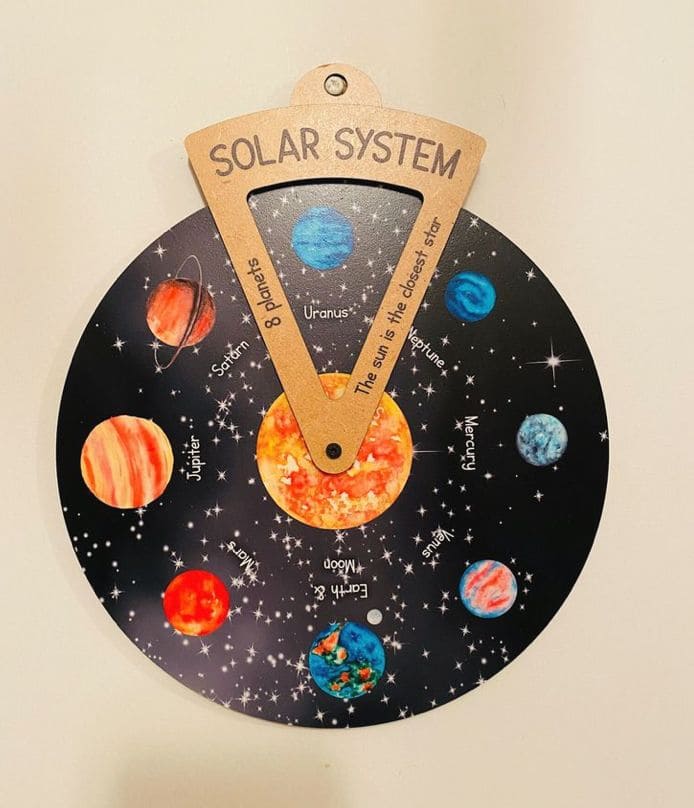
Why not turn planet order into a moving display that invites curiosity every time it spins?
This rotating wheel keeps all eight planets visible while allowing kids to explore relationships through motion.
The layered design naturally reinforces sequencing and scale without feeling like a worksheet. Plus, a simple turn of the pointer becomes a mini discovery moment.
- 2 circular cardboard discs, one 25 cm diameter, one 15 cm diameter
- 1 sturdy cardstock or thin cardboard strip for the pointer, about 18 × 4 cm
- Printed or hand-drawn planet images, 8 pieces, 3–5 cm diameter
- Acrylic paints or markers (black, orange, blue, green, red, brown)
- 1 paper fastener (split pin/brad
- White gel pen or paint pen for labels
- Pencil and ruler
- Scissors
- Glue stick or craft glue
-
Paint the larger cardboard circle black and add scattered white dots to create a starry background.
-
Arrange and glue the planet images evenly around the circle, leaving space for labels beside each one.
-
Write planet names clearly using a white pen, keeping text readable from a distance.
-
Cut the pointer shape from cardstock and label it with simple facts or prompts.
-
Stack the smaller circle and pointer over the center of the large disc.
-
Secure all layers with a paper fastener, making sure the pointer spins smoothly.
#13. Vertical Solar System Foam Board
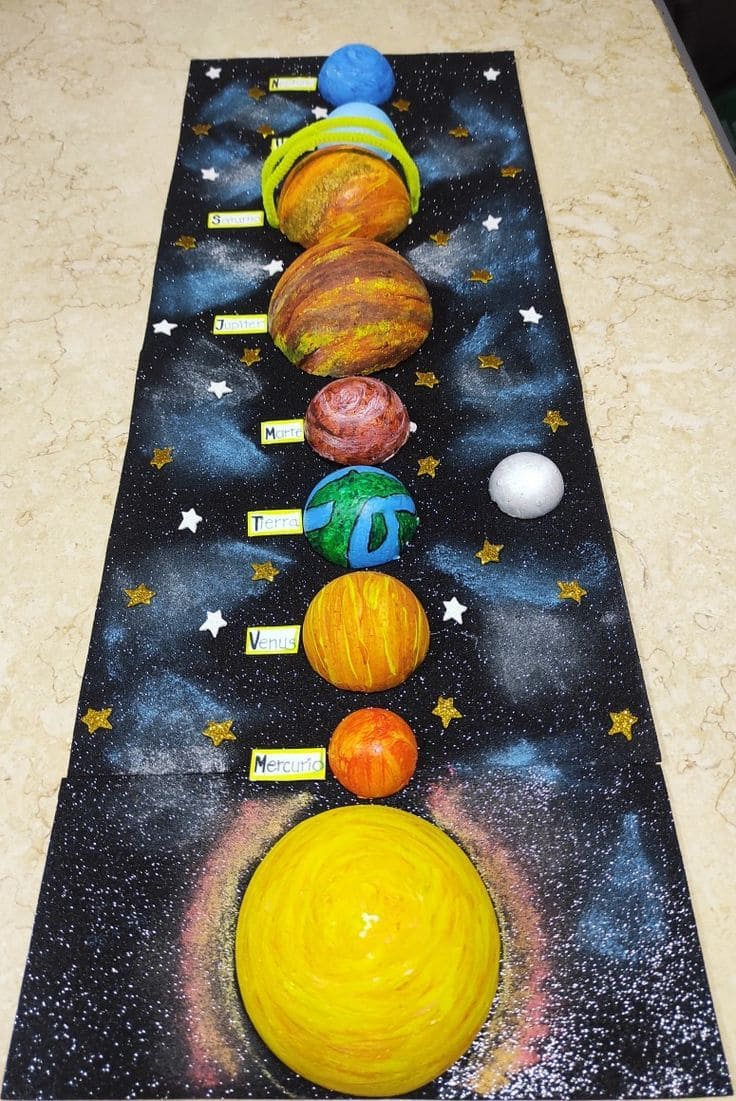
Your view moves naturally from the glowing Sun upward through each planet, making order easy to understand at a glance.
Raised foam spheres give the display depth, turning a simple board into something more tactile and engaging.
The dark, speckled background helps colors stand out while still feeling like outer space. Labels stay small and readable, keeping attention on the planets themselves.
- 1 black poster board or foam board, approx. 30 × 80 cm
- Acrylic paints (yellow, orange, red, blue, green, brown, white)
- 1 small sponge or old toothbrush (for star splatter effect)
- Gold star stickers or gold paint, about 20–30 pieces
- Yellow paper labels, cut into 2 × 5 cm strips
- Craft glue or hot glue gun with 3–4 glue sticks
- Paintbrush set (small and medium sizes)
- 9 foam balls in assorted sizes (Sun ~10–12 cm, planets 2–6 cm diameter)
-
Paint the poster board black, then add white splatter and soft blue clouds to create a space background.
-
Paint each foam ball to represent the Sun and planets, letting them dry completely.
-
Arrange the planets vertically on the board from Sun to Neptune before gluing.
-
Glue each planet securely in place, pressing gently until set.
-
Glue each planet securely in place, pressing gently until set.
#14. Life-Size Solar System Floor Map
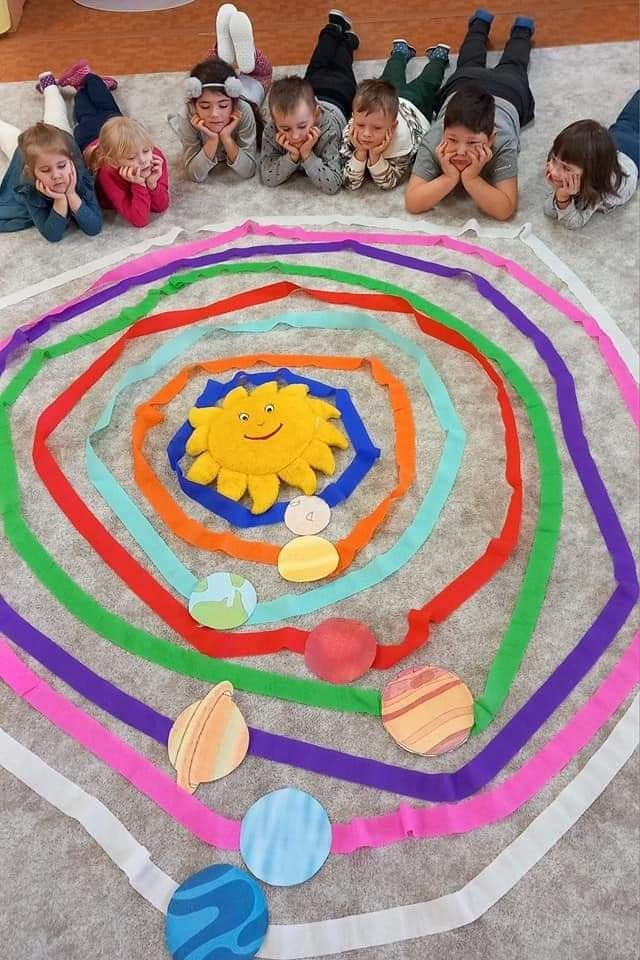
Have you ever seen the solar system stretched out so big that kids can crawl around it? This floor-based setup turns abstract space concepts into something physical and memorable.
Each colorful orbit invites movement, comparison, and group discussion without anyone needing to sit still.
The large scale makes planet order click faster, especially for visual and kinesthetic learners.
- Large floor mat, rug, or felt base, at least 2 × 2 meters
- Colored fabric strips or crepe paper, 6–8 rolls, each about 5–7 cm wide
- Planet cutouts made from cardstock or felt, 8–9 pieces, 12–20 cm diameter
- Double-sided tape or fabric tape
- One Sun cutout (felt or foam), about 25–30 cm diameter
- Optional: labels with planet names, laminated for durability
- Scissors
-
Lay the base mat flat on the floor, making sure there is enough space for children to sit or lie around it.
-
Starting from the center, place the Sun and secure it lightly with tape so it stays visible but removable.
-
Arrange fabric strips in wide circles to represent planetary orbits, adjusting spacing as you move outward.
-
Place planet cutouts along their correct orbits, keeping sizes varied to show differences.
-
Add labels if desired, positioning them near each planet for easy reading.
#15. Glowing Galaxy Jar Solar System
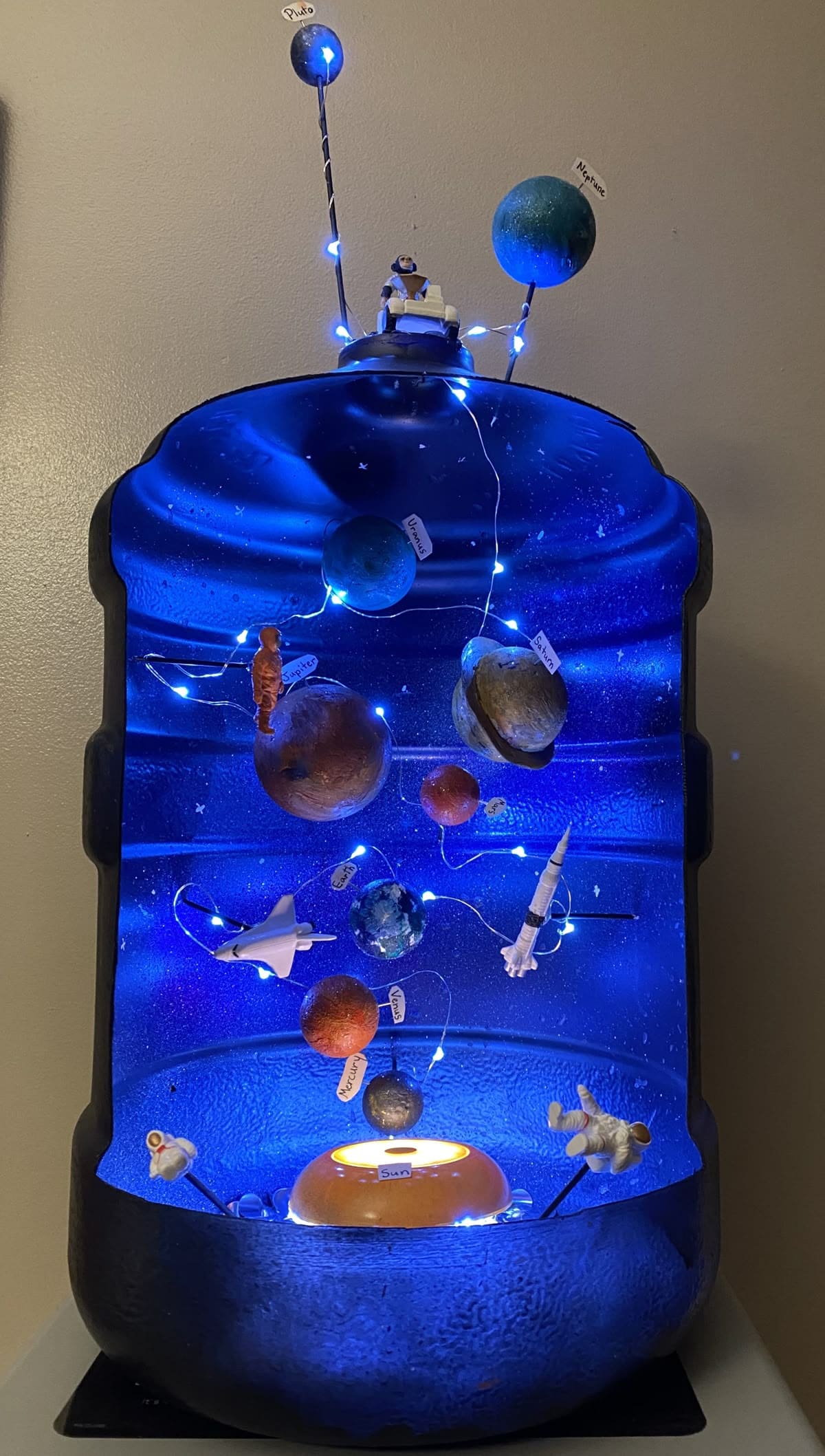
Even a simple container can turn into a dramatic space scene once light and depth come into play. Blue LEDs wash the interior with a cosmic glow, making planets appear suspended in orbit.
Small astronaut figures and rockets add scale, giving the display a sense of exploration rather than just order.
The vertical layout naturally draws the eye upward from the Sun to the outer planets.
- 1 large clear plastic jar or container, approx. 30–40 cm tall
- Blue LED string lights, 2–3 m (battery powered)
- Acrylic paints (blue, black, yellow, orange, red, green, white)
- 4–6 small space figurines (astronauts, rockets, satellites)
- Thin floral wire or skewers, 6–8 pieces, 15–25 cm long
- White paper labels, cut into 1.5 × 3 cm strips
- Hot glue gun with 4–5 glue sticks
- Small paintbrush set
- 9 foam balls (Sun 6–7 cm, planets 2–4 cm diameter)
-
Paint the inside of the container in deep blue and black tones, blending lightly for a space effect.
-
Paint all foam balls as planets, letting them dry fully before handling.
-
Attach planets to wires or skewers and position them inside the container at varied heights.
-
Wrap LED string lights around the interior supports, spacing lights evenly between planets.
-
Glue figurines in place, add labels, then secure the Sun at the bottom as the focal point.
#16. Shadow Box Hanging Solar System
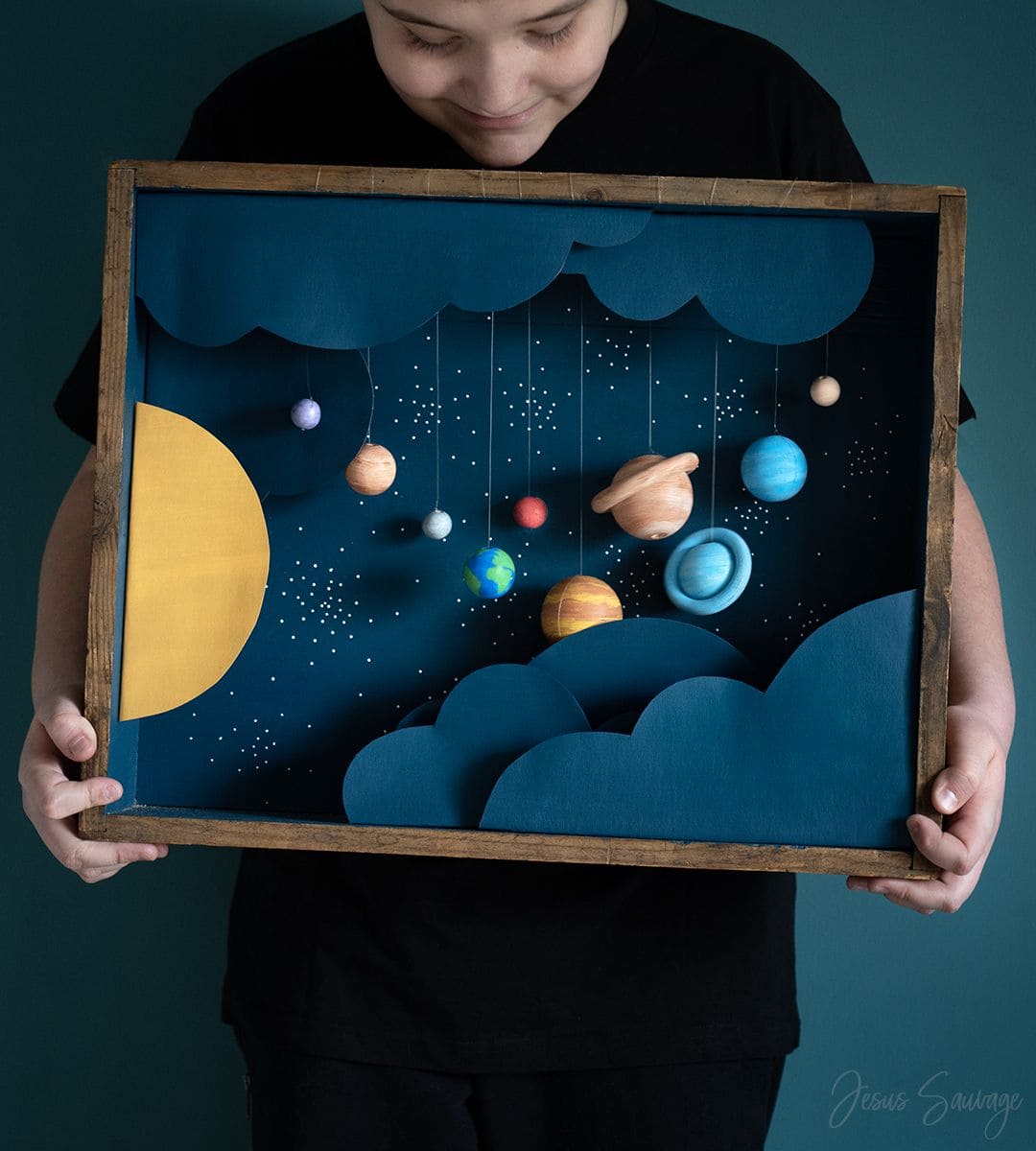
This piece feels more like a storybook scene than a typical science craft. Planets float at different depths, creating a quiet sense of motion and distance inside the frame.
Layered paper clouds soften the space while helping the colors stand out against the dark sky.
The hanging elements naturally draw attention to scale without needing heavy explanation.
- 1 wooden shadow box frame, approx. 40 × 30 cm, depth 5–7 cm
- Cardstock paper in dark blue, light blue, and yellow (A4 size, 3–4 sheets total)
- Acrylic paints (blue, green, red, brown, yellow, white)
- Clear fishing line or thin nylon thread, about 2–3 m total
- Craft glue or hot glue gun with 2 glue sticks
- White paint pen or small brush for stars
- Small hand drill or needle for threading holes
- 9 small foam or wooden balls for planets (1–3 cm diameter)
-
Paint the small balls to resemble planets, adding simple color variations, then let them dry fully.
-
Cut layered cloud shapes and a crescent sun from cardstock, then glue them inside the shadow box background.
-
Use a paint pen or brush to add scattered white dots for stars across the backdrop.
-
Thread fishing line through each planet, adjusting string lengths to create varied hanging depths.
-
Secure the strings to the top inside edge of the frame, spacing planets evenly so they appear to float.
#17. Felt Planet Plushies Set
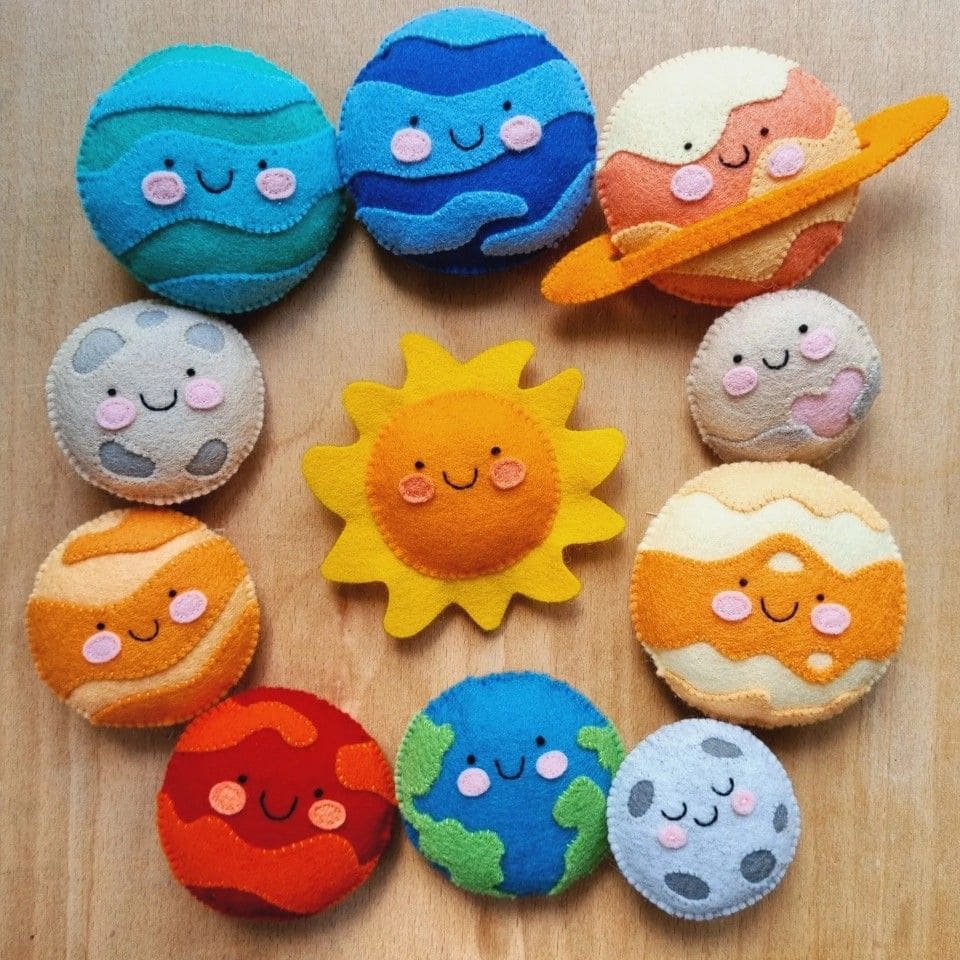
Look at how these soft planets instantly turn the solar system into something warm and approachable. Each piece feels friendly, with gentle colors and stitched smiles that invite touch and curiosity.
The set works beautifully for pretend play, early science talks, or calm shelf decor in a learning space.
It balances creativity with education without feeling overly instructional. This project suits both beginners and experienced crafters who enjoy hand-sewn details.
- Felt sheets in assorted colors, about 20 × 30 cm per 2–3 planets
- Soft stuffing or polyester fiberfill, about 10–15 g per planet
- Embroidery floss (black, pink, white, and accent colors), 2–3 m total
- Hand sewing needle, medium size
- Scissors or fabric scissors
- Fabric chalk or pencil
- Small round template, 7–9 cm diameter
- Optional: pink felt scraps for cheeks, 2–3 cm each
-
Trace and cut two identical felt circles for each planet using your template.
-
Cut decorative shapes for rings, stripes, craters, or continents and stitch or glue them onto one circle.
-
Embroider simple faces with small stitches, keeping expressions soft and minimal.
-
Place the two circles together and stitch around the edge, leaving a 3 cm opening.
-
Place the two circles together and stitch around the edge, leaving a 3 cm opening.
-
Repeat for each planet, varying colors and details to represent the full solar system.
See also: Here’re 20 Lovely Fall Felt Crafts You Must Try This Season
#18. Solar System Fact Flip Cards
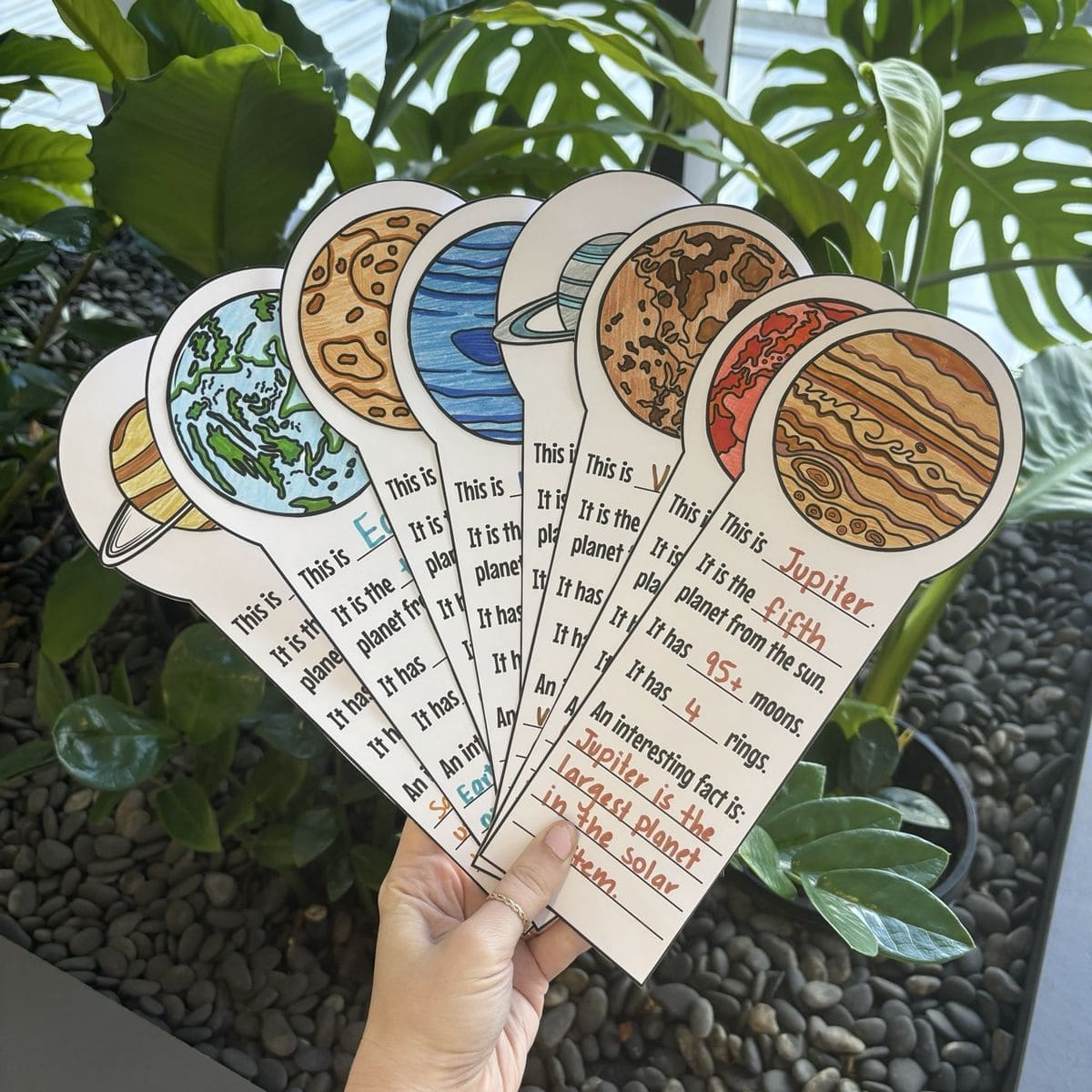
You can also turn planet facts into something interactive that fits right in a child’s hands.
These flip-style cards combine simple illustrations with short, readable information that doesn’t overwhelm young learners.
Each planet feels distinct thanks to hand-colored details and clear labels. The format encourages repetition, making it easy to quiz, review, or play learning games.
- White cardstock or thick paper, A4 size, 5–6 sheets
- Black marker or fineliner for outlines and text
- Colored pencils or markers (blue, green, brown, yellow, red, orange)
- Scissors
- Hole punch (optional, if binding cards together)
- Metal ring or string, about 5–7 cm (optional for card set)
- Ruler and pencil
-
Draw or print planet circles at the top of each card, leaving space below for facts.
-
Write simple prompts such as planet name, order from the Sun, moons, or fun facts.
-
Color each planet carefully, using reference images to add recognizable details.
-
Cut the cards evenly so they stay uniform when stacked or held together.
-
Punch a hole at the bottom corner and secure with a ring, or leave them loose for sorting and games.
#19. Tiered Solar System Orbit Display
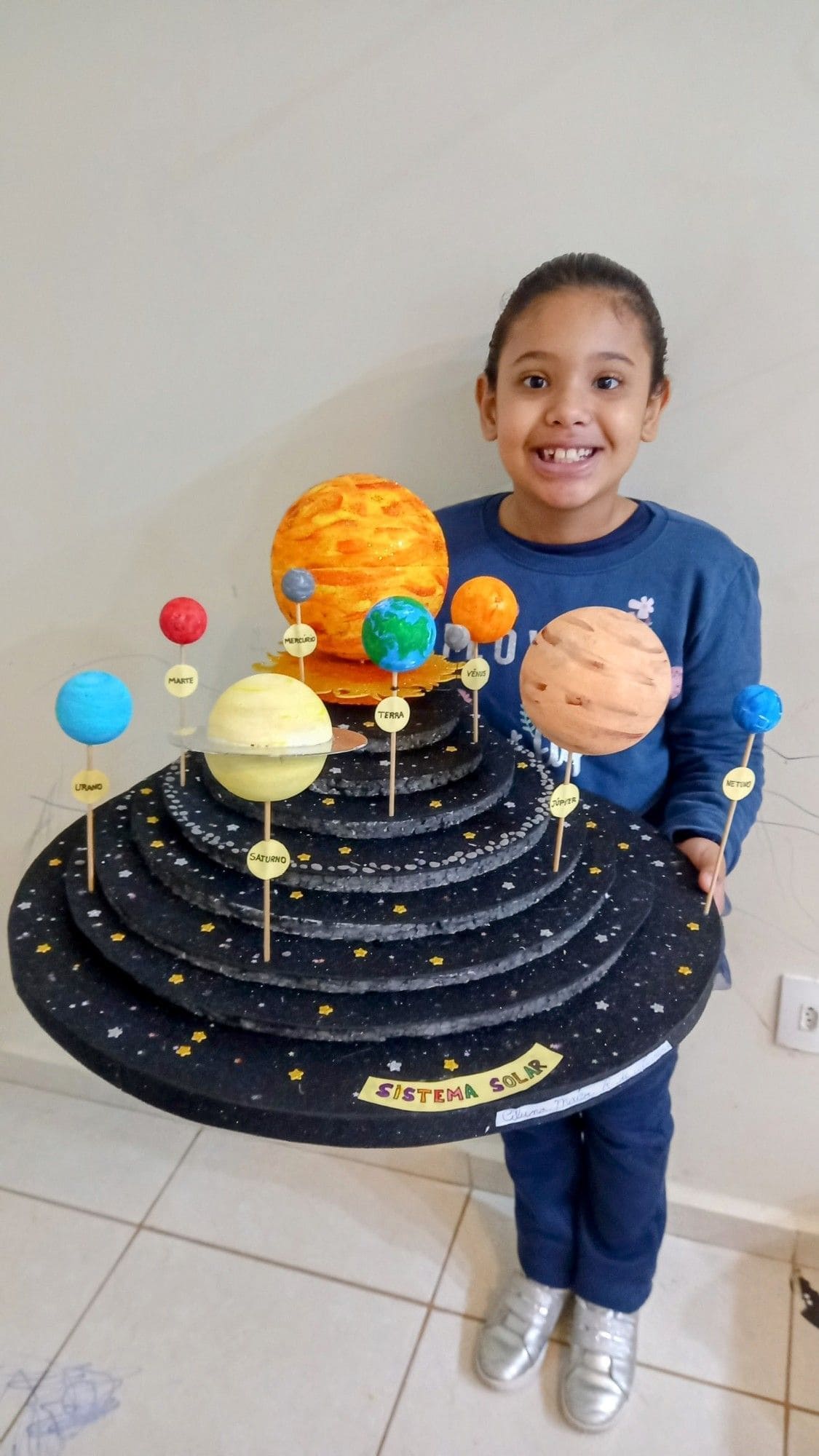
This project turns planetary order into a clear, three-dimensional journey you can follow with your eyes.
Each raised ring represents an orbit, helping distance and placement make sense without explanation.
Foam planets stand upright, evenly spaced, and easy to identify at a glance. The layered base adds structure while keeping the focus on the planets themselves.
- 1 round foam base or stacked foam rings, finished diameter about 40–45 cm
- 9 foam balls (Sun 9–10 cm, planets 2.5–6 cm diameter)
- Black acrylic paint, about 100 ml (base and rings)
- Acrylic paints for planets (yellow, orange, blue, green, red, brown, white)
- Wooden skewers or thin dowels, 9 pieces, 10–15 cm long
- Small round paper labels, about 3 cm diameter
- Craft glue or hot glue gun with 4–5 glue sticks
- Small sponge or toothbrush (star splatter effect)
-
Paint the foam rings and base black, then add white splatter and small star details once dry.
-
Paint the foam balls as the Sun and planets, adding light texture for realism.
-
Stack and glue the rings securely to form a tiered orbit structure.
-
Insert skewers into each planet and push them into the correct ring positions.
-
Attach labeled tags to each skewer and check spacing so all planets remain visible.
#20. Cone-Shaped Solar System Tower
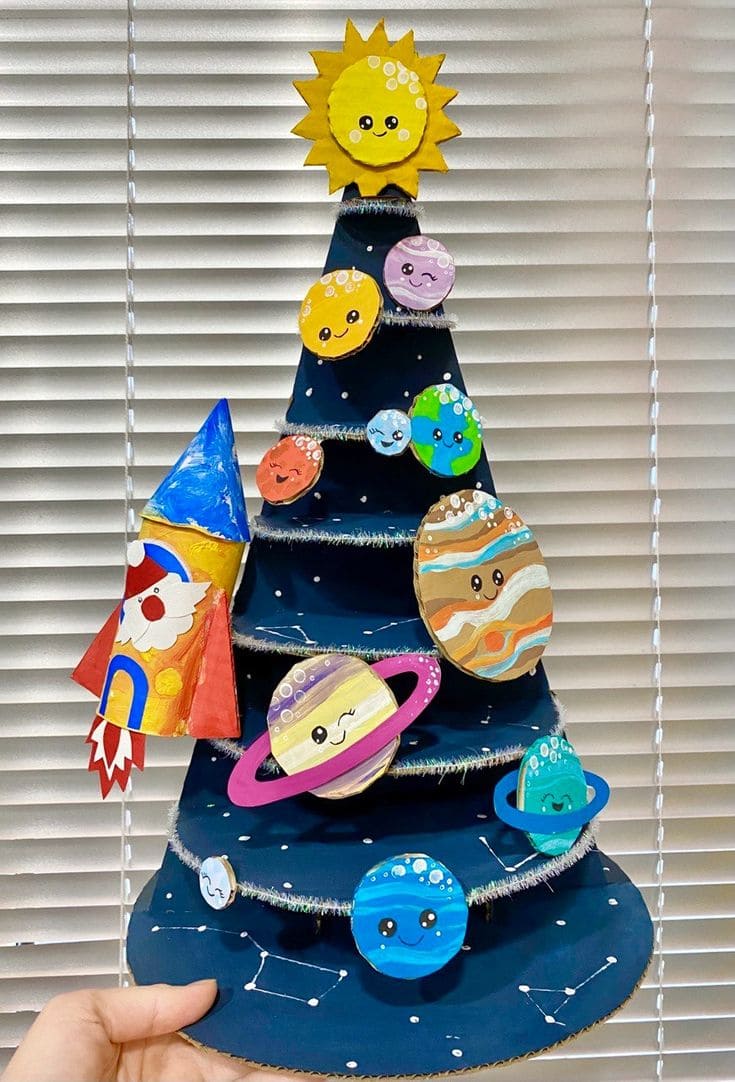
To make the solar system feel cheerful and approachable, this project leans into playful shapes and friendly expressions.
Stacked cone layers guide the eye upward, turning planetary order into a clear visual journey.
Smiling planets soften the science element, making the display feel welcoming rather than instructional. Small details like rings, stars, and a rocket add narrative without overwhelming the structure.
- Cardboard or foam board sheets, enough to cut 4–5 cone layers (largest base about 30 cm diameter)
- Cardstock or thick paper, assorted colors (A4 size, 8–10 sheets)
- Acrylic paints (dark blue, yellow, orange, blue, green, pink, white, brown)
- Pre-cut cardboard circles or hand-cut circles for planets (sizes 4–9 cm diameter)
- White paint pen or fine brush (stars and constellations)
- Silver pipe cleaners or glitter ribbon, about 1–1.5 m total
- Scissors and pencil
- Craft glue or hot glue gun with 4–5 glue sticks
-
Cut cardboard into curved shapes and roll them into cone layers, gluing edges securely and letting them set.
-
Paint each cone dark blue and add white dots, lines, or constellations once dry.
-
Cut and paint planet shapes separately, adding faces, rings, and texture details.
-
Stack the cones from largest to smallest, gluing them together carefully to form a stable tower.
-
Stack the cones from largest to smallest, gluing them together carefully to form a stable tower.
-
Finally, add finishing details like pipe-cleaner rings, a paper rocket, and a smiling Sun at the top.
#21. Textured Solar System Poster Board

If learning works better when textures and visuals come together, this project delivers exactly that.
Raised planets, rocky asteroids, and painted orbit lines turn a flat poster into something interactive and memorable.
The layout clearly shows planetary order while giving extra focus to features like Saturn’s rings and the asteroid belt.
- 1 black poster board, approx. 60 × 90 cm
- 10 foam balls in assorted sizes (Sun ~10 cm, planets 2–5 cm)
- Small pebbles or aquarium gravel, about 1–2 cups (asteroid belt)
- Acrylic paints (yellow, orange, red, blue, green, brown, white)
- 1 silver or white paint pen for stars and orbit lines
- Orange cardstock or paper labels, cut into 3 × 6 cm strips
- Craft glue or hot glue gun with 3–4 glue sticks
- 1 paintbrush set (small and medium sizes)
-
Paint each foam ball to represent the Sun and planets, adding simple textures, then let them dry completely.
-
Arrange the planets on the poster board to plan spacing and orbital paths before gluing.
-
Glue the planets in place, then add pebbles between Mars and Jupiter to form the asteroid belt.
-
Draw curved orbit lines and scatter stars across the background using a paint pen.
-
Write planet names on paper labels and glue them near each object for clear identification.
#22. Sensory Bin Solar System Play Tray
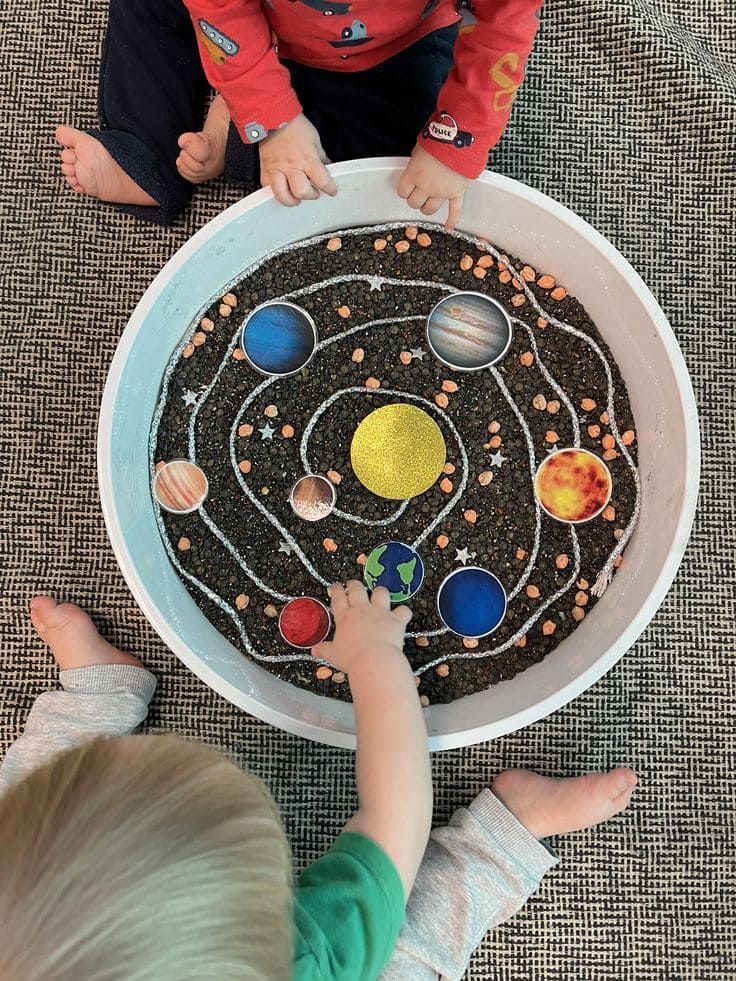
For little hands that learn best through touch, this project turns astronomy into a calm, exploratory experience.
Textured filler creates a clear contrast between space and planets, making each orbit easy to trace with fingers.
Flat planet pieces stay accessible and safe while still encouraging sorting and pointing. The circular layout naturally introduces order without instruction.
- 1 large shallow plastic tray or bin, about 35–45 cm diameter
- Black sensory filler (black beans, lentils, or aquarium gravel), 3–4 cups
- 9 flat planet cutouts or laminated planet images, 4–6 cm diameter
- 1 yellow foam circle or felt circle for the Sun, 6–7 cm diameter
- White glue or glitter glue, 1 small bottle
- Small pebbles or chickpeas, about ½ cup (asteroid details)
- Silver star confetti or stickers, 10–15 pieces
- Laminator or clear tape (optional, for durability)
-
Pour the black filler evenly into the tray, smoothing the surface with your hand.
-
Use glue to draw circular orbit lines directly on top of the filler, working from the center outward.
-
Place the Sun in the center, then position planet cutouts along each orbit.
-
Scatter small pebbles and star confetti to suggest asteroids and background stars.
-
Let children move planets freely, trace orbits, and talk through colors, names, or positions at their own pace.